Correction: In this episode of Trust Control, Kate Kaye inaccurately states that Roger C. Mayer changed his mind about applicability of the ABI trust model to AI after meeting trust researcher John D. Lee at an Air Force conference. However, while Mayer said Lee did attempt to convince him that the ABI model is applicable to AI and inanimate tech, it was Mayer’s son who finally convinced him that the ABI model can be applied to gauging trust in AI, with limits.
Roger C. Mayer and his fellow researchers introduced an influential trust model in 1995 in the Academy of Management Review. The impetus for their work? They were responding to concerns among corporate managers worried that they were losing control of workers in part because more people of color and women were entering the workforce and work team structure was changing. Little did they know that decades later their ABI (Ability, Benevolence and Integrity) trust model would become heavily influential in trust in AI related research.
This episode of Trust Control interrogates the residue of old, questionably applicable ideas perpetuated today in AI trust measurement.
Find the full Trust Control documentary series in most podcast apps or listen to this episode here:
In this episode:
- Corporate motivations for measuring worker trust and trustworthiness
- Why the ABI model may not be right for AI
- How antiquated and sometimes poorly-tested ideas get baked into today’s trust measurement
- Under- and over-trusting AI
- W- E- I -R -D history (Western Educated Industrialized Rich Democratic) of trust measurement
- Military funding of trust measurement from the Cold War to today
Featured in this episode:
- Kate Kaye, Trust Control creator and narrator
- Roger C. Mayer, Professor of Leadership in the Poole College of Management at North Carolina State University
- Bran Knowles, Professor of Sociotechnical Systems at Lancaster University, UK
- Gale Lucas, Director of the Technology Evaluation Lab at the University of Southern California’s Institute for Creative Technologies, Research Associate Professor in USC’s Departments of Civil Engineering, Computer Science and Psychology
- Meredith McNeil, Senior Research Scientist and Team Leader of the Genome to Phenome Team at Commonwealth Scientific and Industrial Research Organisation (CSIRO), Australia
- Andreas Duenser, Research Scientist at Data 61, Commonwealth Scientific and Industrial Research Organisation (CSIRO), Australia
Key References (Mostly) in Order of Appearance
PART ONE
Twenty-four years of empirical research on trust in AI: a bibliometric review of trends, overlooked issues, and future directions by Michaela Benk, et al
2024
An Integrative Model of Organizational Trust
by Roger C. Mayer, James H. Davis, and F. David Schoorman
The Sanction of Authority: Promoting Public Trust in AI
by Bran Knowles and John T. Richards
FAccT ’21: Proceedings of the 2021 ACM Conference on Fairness, Accountability, and Transparency
2021
PART TWO
Designing for Appropriate Reliance in Trust in Automation Trust in Automation
by John D. Lee and Katrina A. See
Human Factors and Ergonomics Society
2004
A New Scale for the Measurement of Interpersonal Trust by Julian Rotter
Journal of Personality
1967
PART THREE
A Novel Method for Trust-Sensitive Design: Applying Conjoint Analysis to Machine-Assisted Genome Annotation
by Melanie McGrath, et al including Andreas Duenser
Proceedings of the Extended Abstracts of the CHI Conference on Human Factors in Computing Systems
2025
Measuring trust in artificial intelligence: validation of an established scale and its short form
by Melanie McGrath, et al including Andreas Duenser
Frontiers in Artificial Intelligence
2025

Task Load Index
by Sandra Hart
NASA Human Performance Research Group
1986
(also see this link)

Participants matter: Effectiveness of VR-based training on the knowledge, trust in the robot, and self-efficacy of construction workers and university students by  Pooya Adami, et al including Gale Lucas
Advanced Engineering Informatics
2023

Trust and Suspicion
by Morton Deutsch
Journal of Conflict Resolution
1958
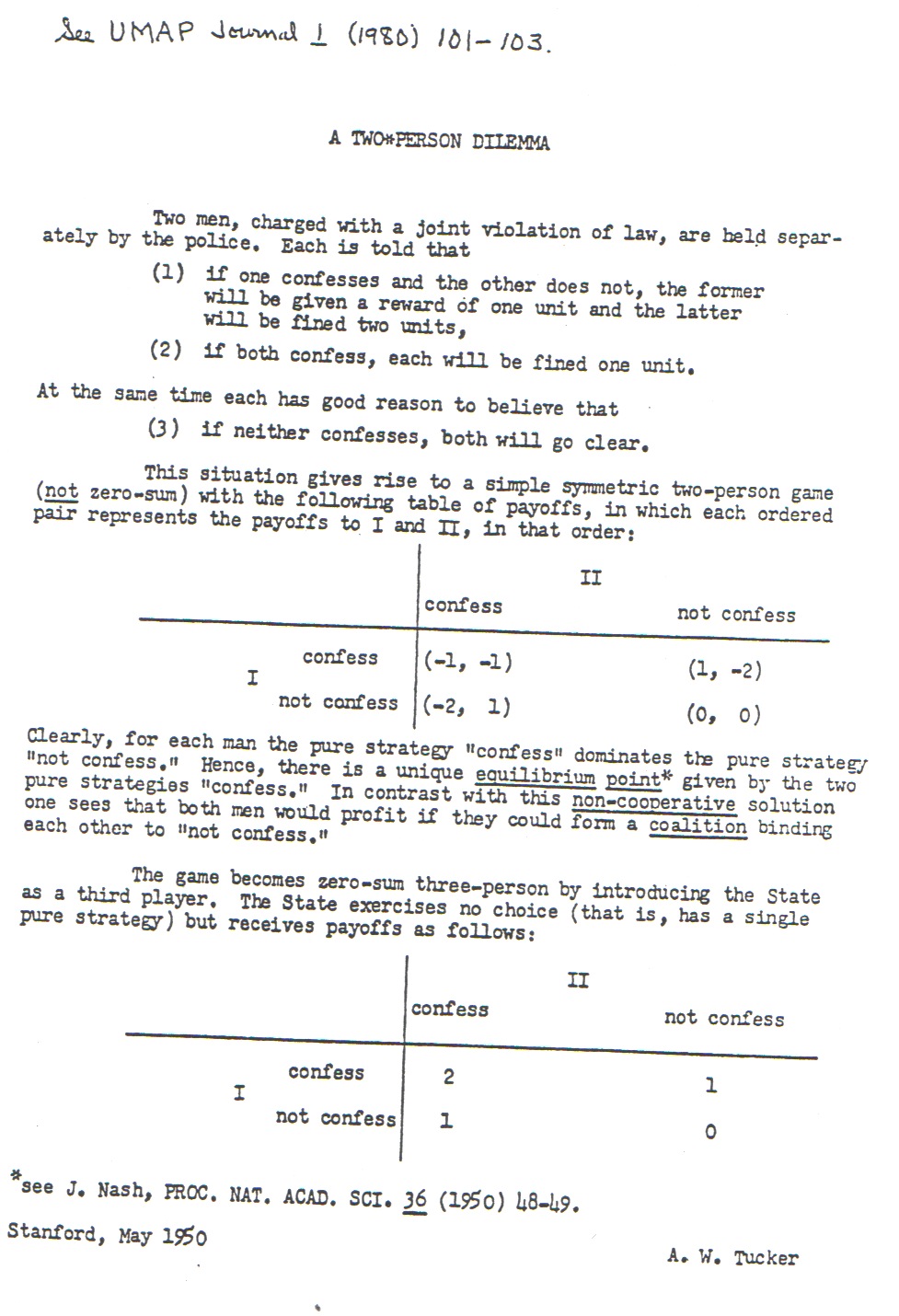
The Original Prisoner’s Dilemma Game distributed at 1950 Stanford University event
(originally called “A Two*Person Dilemma”)
More info here
Foundations for an empirically determined scale of Trust in Automated Systems by Jiun-Yin Jian, et al
Center for Multisource Information Fusion
Department of Industrial Engineering
State University of New York at Buffalo 1998(Also published in the International Journal of Cognitive Ergonomics, 2000)
Trust Control Credits
Trust Control was researched, written, edited and produced by Kate Kaye. All interviews with sources featured in Trust Control were conducted by Kate unless otherwise noted.
Fake ads and silly satire were voiced by Kate Kaye and/or Kyle Huth.
Music
The tunes featured throughout Trust Control were written by D. Rives Curtright and performed by the band Epic Strange from Trust Control’s home of Portland, Oregon:
- D. Rives Curtright: guitar, baritone sax, percussion and drum machine
- Charlie Gotgart: bass
- Steven Francisco: midi keys
- Octavio Dowling: keys
- Dave Coniglio: drums and vibraphone
- Mike McGovern: bass on Decimation
Hear the full Epic Strange album, Nouveau Electric Mess on Soundcloud. Hear music from D. Rives Curtright on Spotify.
The work that went into Trust Control was done in Kate Kaye’s personal time and was supported by Oregon State University’s Patricia Valian Reser Center for the Creative Arts fellowship on Trust in the Age of Generative AI and Oregon Humanities.

Leave a Reply